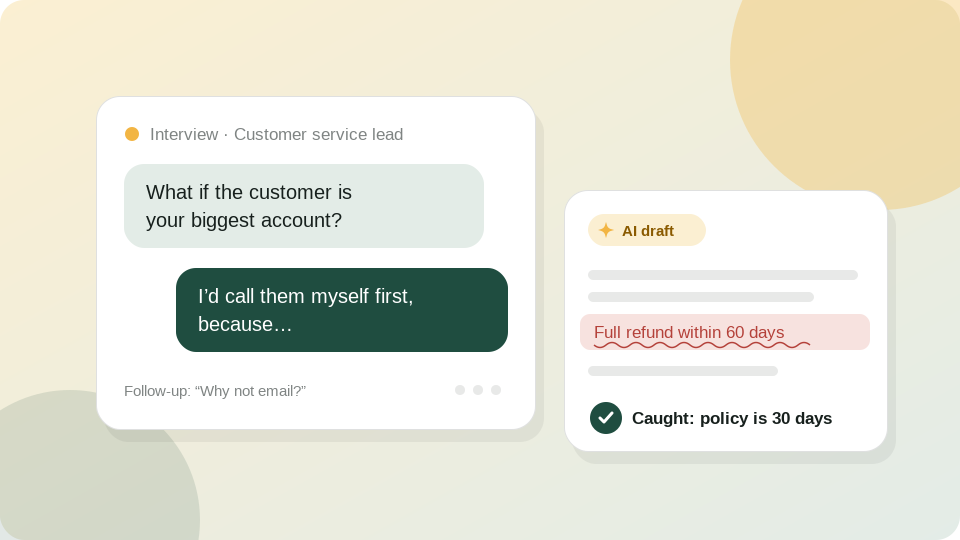
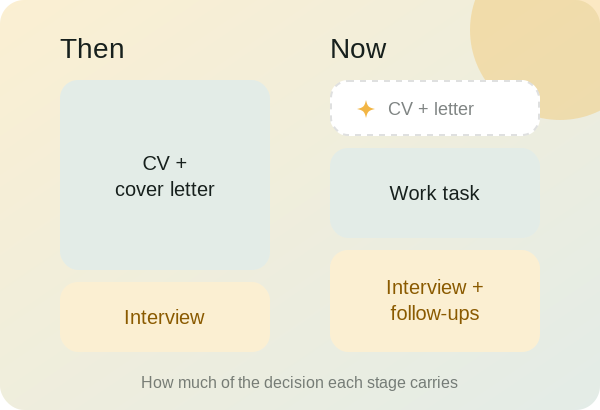
A few years ago a good cover letter still said something about you. It showed you’d made an effort and that you could write. Now anyone can paste a job ad into a chatbot and get a tailored CV and cover letter back in under a minute, and recruiters know this as well as you do. So the written part of an application tells them less than it used to, and more of the decision gets pushed to the interview.
Interviewers have adjusted. They still want to hear about your experience, but they spend more time checking whether you actually understand the work. Can you deal with a messy situation? Would you notice if something was off? Can you explain why you’d do it one way and not another? AI can’t answer those for you in the room.
It can help you prepare, though, probably more than any interview book ever did. This guide covers both sides.
How interviews have changed
The biggest change is that more hiring processes now include some of the actual work. That might be a short written task, a case to discuss, a role play with a difficult “customer” or a simulated workday. It’s much harder to fake doing a task than to fake an answer, and employers have noticed.
You’ll also hear more follow-up questions. If an answer sounds rehearsed, a good interviewer asks why, or what you’d do if one detail were different, and keeps going until they reach the part you really know.
And you’ll very likely be asked how you use AI. A year or two ago that was a question for developers. Now it comes up for customer service, sales, marketing, admin and most other office jobs. “I don’t use it” doesn’t land well, and neither does “I use it for everything”.
Finally, the rules aren’t the same at every stage. One task may let you use any tool you like, while the next one is a live conversation where reading from a screen would be cheating. Part of what employers are watching is whether you can tell the difference.
1. Read the job ad properly
Most of us skim a job ad for the title, the location and the salary. Try reading it as a description of an ordinary working day instead. What would you actually be doing on a Tuesday afternoon? Who would you be talking to, and about what? Which systems would you have open? How would anyone know you were doing a good job?
Pay attention to the phrases that hint at the hard parts. “Fast-paced” usually means interruptions and shifting priorities. “Complex cases” means customers who don’t fit the script. “Many stakeholders” means a lot of people who all want something slightly different.
An AI assistant is useful for this first pass. You could paste the ad in and ask something like:
Read this job ad. What are the five things this person will spend most of their time on? What are the hardest situations they’ll probably face, and what will they be judged on? Then tell me three things the ad doesn’t say that I should try to find out.
Read what comes back with some suspicion. These tools fill gaps with confident guesses, so check every point against the ad itself. Preparing for the job you imagined instead of the one on offer is a common way to have a bad interview.
2. Work out what kind of company it is
The same answer can go down well in one company and badly in another. Say you tell the story of a customer problem you fixed on the spot and only told your manager about afterwards. A ten-person startup may love that. A bank, an insurer or a city department might hear that you skipped an approval you were supposed to get.
So before the interview, try to get a feel for the place. Is it a startup, a growing company, a large established business or the public sector? Does it sell to consumers or to other businesses? Do people make quick calls in small teams, or are there processes and sign-offs for most things? Is something big going on right now, like a new product, a merger or a move into a new market?
AI can give you a quick summary of a company, but it may be out of date or partly made up. Use it to get going, then check the facts that matter on the company’s own website, in recent news and in the ad.
3. Prepare stories about decisions
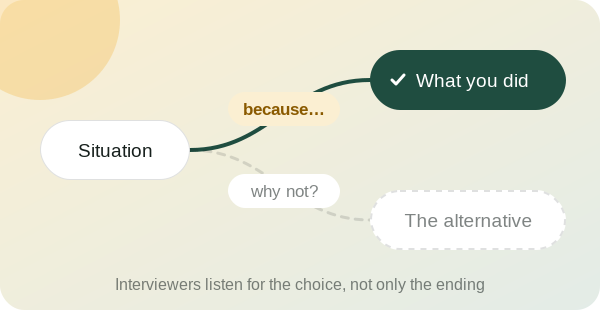
You’ve probably heard of the STAR method (situation, task, action, result), and it still works. What interviewers listen for more closely now is the decision in the middle. Anyone can tell a story that ends well. Fewer people can say what else they could have done and why they didn’t.
It helps to have five or six stories ready. Between them they should cover a difficult customer or colleague, a time you had too much on and had to choose, a mistake you made and what you changed afterwards, and a problem you spotted before anyone else did.
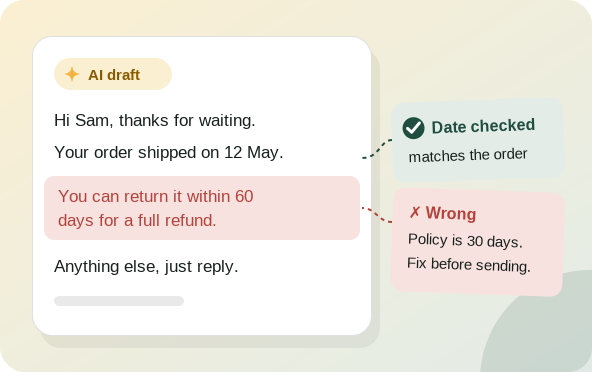
I’d add two more that most candidates don’t prepare. One is about a time you used AI, or any new tool, to do noticeably better work. The other is about a time a tool, a system or a colleague handed you something wrong and you caught it. Together they show the thing employers are now looking for in almost every role, which is using AI without trusting it blindly.
A quick test for each story is to finish the sentence “I chose to … because …”. If you can’t, the story needs more work.
4. Get ready for “How do you use AI?”
This question is about judgement more than enthusiasm. The best answers are specific and include some limits.
Here’s what a good one might sound like from someone in customer service: “I use it to draft first replies to long or messy emails, because it’s quick at untangling what the customer is actually asking. Before anything goes out I check the order details, dates and anything about refunds against our system, because it gets those wrong. I don’t paste customers’ personal details into public AI tools. Overall it saves me time on writing, and I spend that time on the harder cases.”
That answer names a real task, says what gets checked, sets a boundary and explains the benefit. Vague answers like “I use ChatGPT a lot” don’t tell the interviewer anything. If you don’t use AI much yet, just say so, then talk about how you’d start using it in this job and what you’d be careful about. Honest and thoughtful beats impressive and hollow.
5. Practise the work itself
If the employer sends you a task, treat it as part of the interview, because it is. Even if they don’t, one of the best ways to prepare is to do a small piece of the job yourself.
Pick two or three situations from the ad and handle them as if it were your first week. Write the reply to an angry customer. Decide what you’d do when three urgent requests land at the same time. Ask an AI tool to write a summary or a plan, then go through it and find what’s wrong.
Then change something. The customer turns out to be your biggest account, or the deadline moves to today, or your manager is on holiday and can’t be reached. Real work rarely goes to plan, and “what if…” questions are an interviewer favourite. Practising with a twist gets you used to changing course without panicking.
Time yourself too. Hiring tasks often take 20 to 30 minutes, and it’s very easy to spend half of that on the first question.
6. Rehearse with AI, but don’t let it script you
AI makes a decent mock interviewer if you tell it not to go easy on you. Something like this works:
You’re interviewing me for this job: [paste the ad]. Ask me one question at a time. After each answer, ask a follow-up that challenges my reasoning, then tell me honestly what was weak about my answer.
Answer out loud rather than typing, because the real interview will be spoken and it feels very different. You can also ask it directly what an interviewer might doubt about you for this role. That question is uncomfortable, which is why it’s useful.
What you shouldn’t do is learn the AI’s sample answers by heart. Interviewers hear the same smooth, slightly generic phrasing many times a week, and they recognise it. A memorised answer also falls apart at the first follow-up. Use the feedback to improve what you’d say, in your own words.
There’s no need to give the chatbot your full name, address or details about other people to practise. Leave them out.
7. In the interview, think out loud
When you get a question or a task, how you get to your answer counts as much as the answer itself.
If something isn’t clear, say what you’re assuming and carry on. “I’ll assume the customer has already contacted us twice, so I’d start by…” is far better than going quiet. Use the details you’ve been given, like the deadline, the budget or the name of the customer. Answers that ignore them sound generic, and generic is exactly what interviewers are trying to filter out these days.
It’s fine to say you don’t know something, as long as you say how you’d find out. And when there’s a choice to make, explain the trade-off: “I’d go with A rather than B here, because…”. That single sentence shows more understanding than a perfect answer recited without one.
8. Know when AI is allowed
If a stage allows AI, use it the way you would at work, openly, with your own judgement on top. If it doesn’t, don’t. Reading generated answers during a live interview isn’t fair on the other candidates, and interviewers usually notice. Even if you got away with it, you’d end up in a job you can’t do yet.
If you’re not sure, ask: “Am I allowed to use AI tools for this?” It’s a normal question now, and how they answer tells you something about the company as well.
One more thing on take-home tasks. If they include the company’s own documents or data, don’t paste them into a public AI tool unless they’ve told you it’s fine. Being careful with information is part of what they’re assessing.
9. Ask good questions back
The questions you ask at the end show how you think, so it’s worth preparing a few. Some that suit the moment are how the team uses AI tools today and where they expect people to use their own judgement, how the role has changed over the last year or two, what a new person does in their first month that makes the team think they hired well, and what the hardest situations in the job tend to be.
If you have a week
- Day 1: go through the ad and note the tasks, people, tools and what counts as good work.
- Day 2: research the company and how it works.
- Day 3: write your five or six stories, each with its “I chose to … because …”.
- Day 4: prepare your answer about AI and your questions for them.
- Day 5: do two or three tasks from the job, with a twist, against the clock.
- Day 6: a tough mock interview with AI, out loud, then work on whatever was weak.
- Day 7: rest, reread your notes and sort out the practical details.
Finally
AI hasn’t made interviews easier or harder so much as moved what they test. A polished answer doesn’t prove much any more. What still counts is showing that you understand the work. You use the details in front of you, you cope when the situation changes, you spot the mistake and you can explain why you chose what you did.
Prepare for that, and let AI help you get there.